Factory direct from China · Free samples within 48 hours · Response time < 2 hours EMAIL: sales@PLASTICPACKAGINGCHINA.com WhatsApp +8618335151382
HDPE Bottle Manufacturer in China — Chemical-Resistant HDPE Packaging for Industrial Brands
Specialized HDPE bottle manufacturer serving 300 brands across 45 countries. White HDPE, natural HDPE, colored HDPE — chemically resistant, opaque, dishwasher-safe. The industry standard for detergent, shampoo, supplement, household, and chemical product packaging. FDA 21 CFR 177.1520 compliant.
HDPE Plastic Packaging
The Leading HDPE Bottle Manufacturer in China for Industrial and Consumer Brands
Introduction
HDPE, or High-Density Polyethylene, is one of the most widely manufactured plastics in the world. It powers Tide and Ariel laundry detergent bottles, Pantene and Head & Shoulders shampoo bottles, Centrum and Nature Made supplement bottles, and the vast majority of opaque household packaging on global retail shelves. Chemically resistant, opaque to block UV, easy to squeeze, and 100% recyclable — HDPE is the material every industrial brand reaches for when product chemistry and consumer durability both matter.
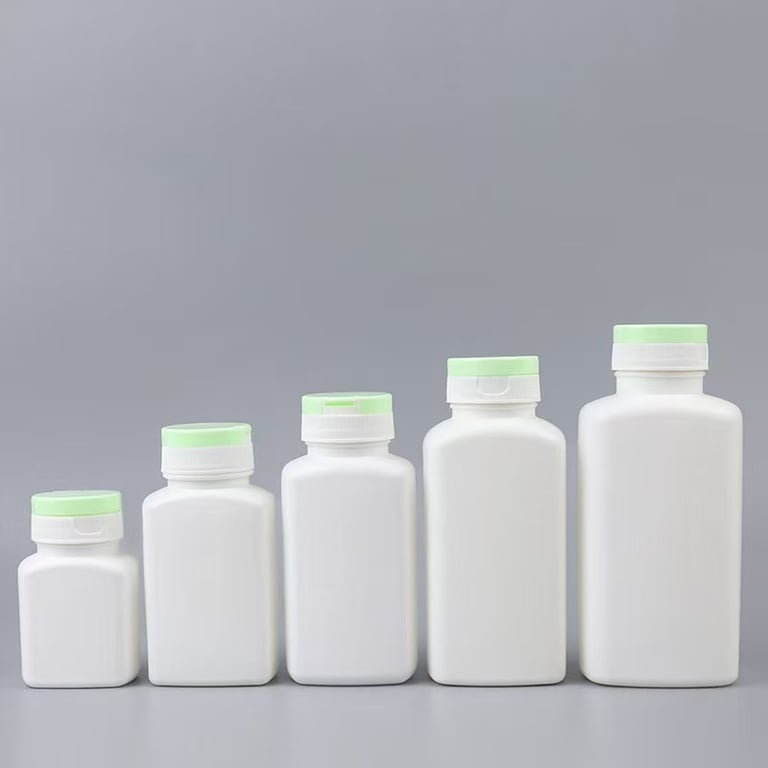
For 15 years, PureForm Pack has built its reputation as a specialized HDPE bottle manufacturer in China, producing over 250 million HDPE bottles annually for international brands across 45 countries. Our HDPE operations cover the full spectrum from small 30cc supplement bottles to 5-liter laundry detergent containers, from white HDPE to natural HDPE to fully Pantone-matched colored HDPE.
What makes us different is depth, not breadth. We focus on two HDPE manufacturing processes (Extrusion Blow Molding and Injection Molding for closures), chemical compatibility testing for surfactants, bleach, alcohols, acids, and bases, and full regulatory compliance (FDA, EU 10/2011, REACH, California Prop 65). Combined with our location 90 minutes from the Port of Tianjin, we deliver HDPE bottles to US East Coast and EU buyers faster than South China factories.
HDPE Properties
Why Industrial Brands Choose HDPE Packaging
HDPE combines six critical properties that make it the dominant plastic for chemical-resistant and opaque packaging. Understanding each helps you select the right material for your product.
🧪
Excellent Chemical Resistance
Resistant to most acids, bases, alcohols, and surfactants. Compatible with bleach, ammonia, detergents, and aggressive cleaning formulas — where PET would degrade.
🌑
Natural Opacity
White and natural HDPE are opaque by default. Blocks UV light and visible light to protect light-sensitive products like supplements, vitamins, and oils.
💪
High Impact Resistance
Excellent impact resistance and stress crack resistance. Withstands drops, transit shocks, and rough handling — ideal for retail and industrial applications.
🤏
Squeezable Flexibility
Softer and more flexible than PET. Ideal for products that need to be squeezed out — dish soap, shampoo, ketchup, hand lotion, and squeeze-dispenser packaging.
🛡️
BPA-Free Safety
HDPE contains no BPA, BPS, or phthalates. FDA-approved for direct food contact since the 1960s. Used for milk jugs, baby bottles, and food storage.
♻️
Recyclable Code #2
One of the most widely recycled plastics globally. Accepted in nearly every curbside recycling program. Recycled HDPE (rHDPE) available in 30 to 100 percent recycled content.
Understanding HDPE as a Packaging Material
HDPE Technical Deep Dive
What is HDPE (High-Density Polyethylene)?
HDPE is a thermoplastic polymer made from ethylene gas through a polymerization process under low pressure. First commercialized in 1953 by Karl Ziegler in Germany, HDPE quickly became one of the world's most produced plastics due to its remarkable balance of strength, chemical resistance, and cost-effectiveness.
The "high-density" designation refers to its molecular structure: HDPE has long, linear polymer chains with minimal branching. This linear structure packs the molecules tightly together, creating a density of 0.93-0.97 g/cm³ — denser than its cousin LDPE (low-density polyethylene), which has a more branched structure.
HDPE is identified by the resin identification code "2" inside the triangular recycling symbol — one of the most widely recycled plastics worldwide, with curbside acceptance in virtually every developed market.
A complete technical overview of HDPE chemistry, manufacturing, and performance characteristics — for buyers who want to make informed material decisions.
HDPE Performance Characteristics
HDPE's properties make it uniquely suited to chemical and consumer packaging:
Density: 0.93-0.97 g/cm³ (heavier than water minus)
Tensile strength: 22-31 MPa
Melting temperature (Tm): 120-135°C
Maximum service temperature: 100°C continuous
Minimum service temperature: -50°C (excellent cold resistance)
Light transmission: Opaque to translucent (typically blocks 95+ percent of visible light)
Chemical compatibility: Excellent with most acids, bases, alcohols, surfactants
HDPE Manufacturing Chemistry
HDPE production starts with ethylene gas, which polymerizes using metal catalysts (Ziegler-Natta or metallocene). The resulting resin pellets are then processed through:
Extrusion blow molding (EBM) for hollow bottles and containers
Injection molding for caps, closures, and small precision parts
Blow film extrusion for plastic bags and liners
Sheet extrusion for HDPE board and panels
For bottle production, the most common method is EBM (Extrusion Blow Molding) — a continuous process where molten HDPE is extruded as a hollow tube (parison) and then blown into shape inside a mold. This method is cost-effective for opaque bottles in capacities from 30ml to 30 liters.
HDPE Limitations to Understand
HDPE is not the best choice for every application. Key limitations:
No clarity: opaque by nature — not suitable for products needing visibility (use PET instead)
Limited gas barrier: permeable to oxygen and CO2 — not suitable for carbonated drinks or oxygen-sensitive products without coatings
Solvent sensitivity: degrades under prolonged contact with strong oxidizers, aromatic solvents, and certain hydrocarbons
Stress cracking: can occur under stress with certain surfactants — formula compatibility testing recommended
Lower stiffness: softer than PET — bottles can deform under heavy weight or stacking pressure
For products requiring crystal clarity or gas barrier (carbonated drinks, premium serums), PET or PETG are better choices. For maximum chemical and heat resistance (hot-fill products), PP is often preferred. Our material engineers help match the right resin to your specific formula and process requirements.
Material Comparison
HDPE vs PET vs PP vs LDPE — Complete Comparison
The four most common plastic packaging materials compared side-by-side. Understand which material is optimal for your specific product, brand positioning, and budget.
Quick Material Selection Guide
Choose HDPE when: you need chemical resistance, opacity for light-sensitive products, squeeze flexibility, or impact toughness. Best for laundry detergent, shampoo, dish soap, supplement bottles, household cleaners, and milk jugs.
Choose PET when: you need crystal clarity, lightweight construction, gas barrier for carbonated products, or premium brand visibility. Best for water, juice, soft drinks, premium cosmetics, supplement bottles, and personal care.
Choose PP when: you need hot-fill capability, microwave compatibility, or maximum acid and base resistance. Best for hot-filled sauces, sports bottles, kitchen cleaners, and reusable food containers.
Choose LDPE when: you need maximum flexibility and squeezability for tube-style packaging. Best for cosmetic squeeze tubes, hand cream tubes, plastic bags, and films.
HDPE Bottle Buyer's FAQ
Frequently Asked Questions
What is HDPE plastic used for?
HDPE (High-Density Polyethylene) is the workhorse plastic for opaque bottles and chemical-resistant packaging. It is used for laundry detergent bottles, shampoo and conditioner bottles, household cleaners, supplement and vitamin bottles, milk jugs, motor oil bottles, and bleach bottles. HDPE offers excellent chemical resistance, opacity that blocks UV light, and easy squeeze flexibility for dispensing products.
Is HDPE safe for food and supplement contact?
Yes. HDPE is FDA-approved for food contact under FDA 21 CFR 177.1520 and EU 10/2011. It is BPA-free, BPS-free, and phthalate-free. HDPE is the global standard for milk jugs, supplement bottles, and food-grade containers. The FDA has approved HDPE for direct food contact since the 1960s, with decades of safety data behind it.
What is the difference between HDPE and PET?
HDPE is opaque, chemically resistant, and softer — ideal for detergents, shampoos, supplements, and household products. PET is crystal clear, lightweight, with excellent gas barrier — ideal for beverages, water, and products needing visibility. HDPE is best for chemical resistance and opacity; PET is best for clear premium products. HDPE bottles are also easier to squeeze, which matters for products dispensed by squeezing.
Can HDPE bottles be recycled?
Yes. HDPE is identified as recycling code #2 — one of the most widely recycled plastics globally. Curbside recycling programs in virtually every developed country accept HDPE. We also offer recycled HDPE (rHDPE) options in 30, 50, and 100 percent post-consumer recycled content for brands committed to sustainability goals and EU regulations.
What is the MOQ for custom HDPE bottles?
Standard MOQ is 5,000 pieces per SKU for stock HDPE bottles. Custom molded designs require 10,000 pieces or more. Custom decoration adds minimal MOQ impact when paired with bottle order. We support startup brands with flexible MOQs on selected SKUs — contact our sales team for current stock and special pricing.
Can HDPE bottles be used for bleach and harsh chemicals?
Yes. HDPE is highly resistant to most household and industrial chemicals including bleach (sodium hypochlorite), ammonia, hydrogen peroxide, and most acids and bases. For long-term bleach storage, we recommend UV-stabilized HDPE which prevents material degradation from chlorine over 6+ months. Our chemical compatibility team can verify your specific formula compatibility before production.
Can HDPE bottles be hot-filled?
HDPE can withstand temperatures up to 100°C continuously, making it suitable for warm-fill applications. For products requiring true hot-fill above 100°C (sterilized products, hot-packed sauces), PP is the better choice as it handles up to 121°C. For most household and supplement applications where fill temperatures stay below 90°C, HDPE works perfectly.
What is the typical lead time for HDPE bottle orders?
Stock HDPE bottles: 15-20 days production. Custom molded designs: 30-45 days including mold making. Custom decoration adds 5-10 days. Shipping adds 25-40 days FOB Tianjin to most international destinations. Total order-to-warehouse: 40-95 days depending on customization complexity.
Ready to Source HDPE Bottles?
Get a free detailed quote within 24 hours. Free samples available within 48 hours. As a specialized HDPE bottle manufacturer in China, we make sourcing fast, FDA-compliant, and chemically-tested for industrial and consumer brands.
By Application
Leading plastic packaging manufacturer in China specializing in food, pharmaceutical, cosmetic and household bottles. FDA & ISO certified. Serving 500+ global brands since 2009.
© 2025. All rights reserved.
Factory: Cangzhou,Hebei, China
Email: sales@plasticpackagingchina.com
Phone: +8618335151382
WhatsApp / WeChat: +86 183 3515 1382
Tritan Sports Bottles