Factory direct from China · Free samples within 48 hours · Response time < 2 hours EMAIL: sales@PLASTICPACKAGINGCHINA.com WhatsApp +8618335151382
Plastic Packaging Types Explained: A 2026 Buyer's Guide for Brands Sourcing from China
A practical, no-fluff guide to plastic materials, manufacturing methods, and sourcing decisions — written by an experienced plastic packaging manufacturer in China that has shipped over 500 million units to brands across 60+ countries.
PureForm
5/8/20269 min read
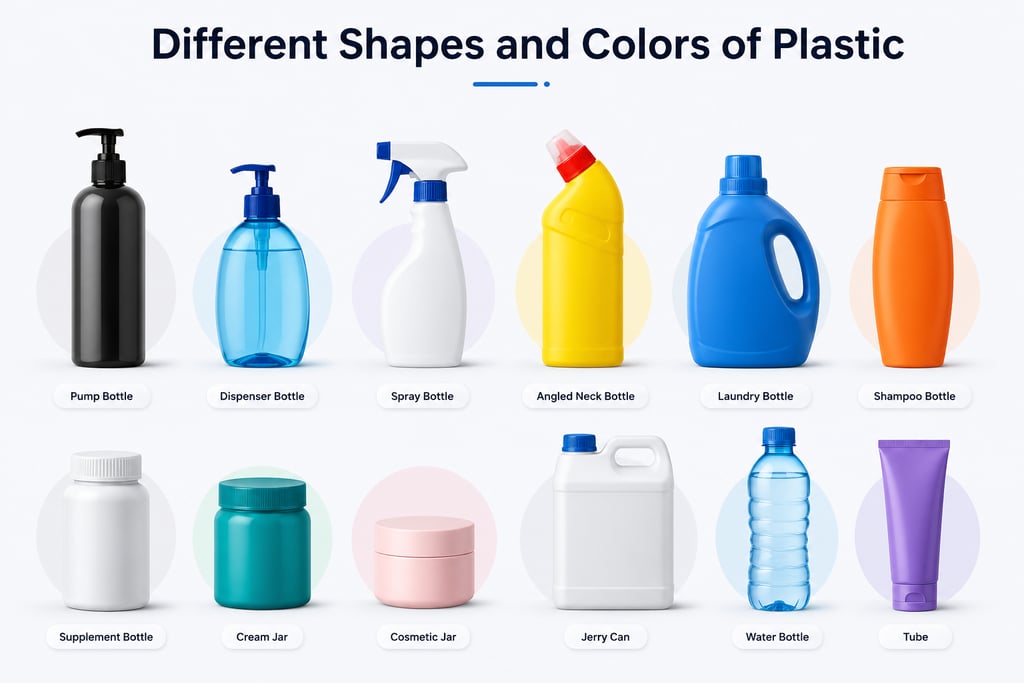
If you are a brand owner, product manager, or sourcing specialist preparing to import plastic packaging from China, you have probably realized something frustrating: most online articles about plastic packaging are written for engineers, not buyers.
They walk you through the chemistry of polymerization, the physics of blow molding, and tables of melting points — none of which actually help you decide whether your supplement brand should use PET or HDPE bottles, or whether your factory should run extrusion blow molding or injection stretch blow molding for your product line.
This guide is different. As a plastic packaging manufacturer in China that has built over 1,200 custom molds and shipped to brands ranging from US supplement startups to French cosmetic houses to UAE food distributors, we wrote this guide from the buyer's seat. Every section answers one question: "What does this mean for my purchasing decision?"
1. The 6 Plastic Materials Used for Packaging
Before we dive into materials, here is the executive summary every buyer needs to memorize:
PET (Polyethylene Terephthalate)
If your product needs to be seen — sparkling water, juice, supplements with capsules, premium edible oil, hair serum — PET is almost always the answer. It is crystal clear, lightweight, holds up to carbonation pressure, and has the best gas barrier properties among common plastics.
From a sourcing perspective, PET is also the most commodity-priced plastic, meaning competition between Chinese factories drives unit prices down for stock products. A 500ml PET bottle can cost as little as $0.08–$0.15 per unit at high volumes. PET is also recyclable (resin code #1), which matters increasingly for EU and California compliance.
Watch out for: PET softens above 70°C, so it cannot be used for hot-fill foods. Also, untreated PET allows some oxygen permeation over time, which affects long shelf-life products like tomato sauce.
HDPE (High-Density Polyethylene)
HDPE is the workhorse of pharmaceutical, supplement, and household chemical packaging. It is opaque (perfect for protecting light-sensitive vitamins), highly resistant to chemicals (acids, bases, cleaning solutions), and has excellent moisture barrier properties — all of which matter for products that need to last 2-3 years on a shelf.
For B2B buyers in supplements, pharmaceuticals, and household cleaning, HDPE is the default choice. It is FDA compliant for food contact, withstands UV exposure with stabilizers, and supports the child-resistant cap mechanisms that US and EU markets require for pill bottles.
Watch out for: HDPE cannot be made transparent. If your brand wants product visibility (showing capsules through the bottle), you'll need to switch to PET or PP — but understand you may sacrifice some chemical resistance.
PP (Polypropylene)
Polypropylene is the heat-resistant champion. It withstands hot-fill temperatures up to 121°C, survives microwaving, and tolerates dishwasher cycles. This makes PP the go-to for hot-filled foods, sports water bottles, kitchen storage containers, and reusable consumer products.
PP also offers semi-transparent visibility — not as clear as PET but better than HDPE. For supplement brands wanting partial product visibility on a heat-stable bottle, PP is a smart middle ground.
Watch out for: PP becomes brittle in sub-zero temperatures. If your product will be shipped or stored in freezing conditions, talk to your plastic packaging manufacturer in China about oriented PP (OPP) formulations that perform better in cold environments.
LDPE (Low-Density Polyethylene)
LDPE is HDPE's softer cousin. It is flexible, squeezable, and ideal for tubes, condiment bottles, lotion squeeze containers, and specialty packaging where a tactile feel matters. Cosmetic and personal care brands often choose LDPE for lotion and shampoo squeeze tubes.
Watch out for: LDPE has lower chemical resistance than HDPE and costs slightly more. Most LDPE bottles use compression molding rather than blow molding, which means different MOQs and lead times.
PC (Polycarbonate)
Polycarbonate offers glass-like clarity with the durability of plastic — perfect for premium reusable water bottles, baby bottles, and laboratory vessels. Its ability to withstand repeated sterilization (autoclaving) makes it valuable in healthcare and foodservice.
Watch out for: PC contains BPA, which has triggered regulatory scrutiny in the EU, US, and Asia. Most modern PC suppliers offer BPA-free alternatives like Tritan, but expect to pay 30-50% more. For US and EU markets, BPA-free is increasingly non-negotiable.
PVC (Polyvinyl Chloride)
PVC is rare in food and beverage packaging today due to migration concerns, but remains common in industrial bottles, pharmaceutical containers (where regulatory pathways are clear), and specialty products like medical tubing.
If you are a buyer outside heavy industrial or pharmaceutical sectors, you almost certainly do not need PVC packaging — and most reputable plastic packaging manufacturers in China will steer you toward HDPE or PET alternatives.
2. How Plastic Packaging Is Actually Made
You don't need to be an engineer, but understanding manufacturing methods helps you ask smarter questions during supplier negotiations and avoid being upsold to expensive processes you don't need.
There are essentially three methods used by every plastic packaging manufacturer in China:
Extrusion Blow Molding (EBM)
The most common method, especially for HDPE bottles. Molten plastic is extruded into a tube (called a parison), the mold closes around it, and air pressure inflates the parison against the mold walls.
What this means for buyers: EBM is fast and cheap, ideal for opaque bottles with simple shapes. Most pharmaceutical, supplement, and household chemical bottles are made this way. Lower tooling cost ($800-$2,500 per mold) makes EBM ideal for startups testing small batches.
Injection Blow Molding (IBM)
Two-stage process: plastic is first injection-molded into a preform (looks like a thick test tube with a finished neck), then transferred to a blow-molding station where it is inflated into the final shape.
What this means for buyers: IBM produces bottles with extremely precise neck finishes — important when you need a perfectly fitting screw cap, child-resistant closure, or pump dispenser. It costs more than EBM but delivers superior dimensional consistency. Pharmaceutical and supplement bottles often use IBM.
Injection Stretch Blow Molding (ISBM)
An advanced version of IBM where the preform is biaxially stretched during inflation. This molecular alignment dramatically improves clarity, strength, and gas barrier properties.
What this means for buyers: ISBM is the standard for clear PET bottles — water, soda, juice, premium cosmetics. The biaxial orientation lets you create thinner walls without sacrificing strength, which lowers material cost per bottle at high volumes. ISBM tooling costs more upfront ($2,000-$5,000) but per-unit costs drop fast above 100K-unit production runs.
Buyer's Pro Tip
When you contact a Chinese factory, do not start by specifying the plastic type. Instead, describe your product (what it contains, target market, shelf life, fill temperature, retail environment) and let the factory's engineers recommend the optimal material. This often saves 10-20% on costs and avoids late-stage compliance issues.
3. Sourcing Plastic Packaging from China: What Buyers Should Know
China produces an estimated 30-35% of the world's plastic packaging. As a plastic packaging manufacturer in China ourselves, we'll be honest about what makes Chinese sourcing work — and where buyers commonly get burned.
Why Brands Source from China
Three reasons drive most overseas buyers to Chinese factories:
Price advantage of 30-50% compared to Western suppliers, even after shipping and duties
Mold flexibility — Chinese factories will open custom molds for $800-$8,000, vs $5,000-$30,000 in Europe or the US
Vertical integration — many Chinese factories handle mold-making, production, decoration, and packaging in-house, simplifying supply chain management
The 5 Pitfalls Buyers Hit
These are the recurring mistakes we see new importers make. Avoid them and your sourcing experience improves dramatically:
Pitfall 1: Choosing the cheapest quote. The cheapest factory often skimps on resin quality (using off-spec or recycled resin labeled as virgin), which causes downstream issues like discoloration, brittleness, and migration test failures. Always compare apples to apples.
Pitfall 2: Skipping the FDA / SGS test reports. A reputable plastic packaging manufacturer in China will provide third-party test reports for every order. If a factory cannot produce these documents on demand, that's a major red flag.
Pitfall 3: Not getting the mold ownership clause in writing. Many Chinese factories use mold-hostage tactics to lock buyers into long-term relationships. Insist on a written clause that mold ownership transfers to you after a defined production volume (typically 100,000 units).
Pitfall 4: Ignoring port logistics. A factory near Tianjin or Shanghai port saves 3-7 days vs an inland factory. For US East Coast and EU buyers, North China factories (Tianjin region) often provide faster transit times than South China alternatives.
Pitfall 5: Underestimating MOQ flexibility. Many factories quote 50,000+ MOQ as their default, but most will accept 5,000-10,000 if you ask. Always negotiate.
What to Ask Before Signing
Before placing your first order with any plastic packaging manufacturer in China, get written answers to: (1) What resin grade and supplier are you using? (2) Can you provide FDA, SGS, and migration test reports? (3) Who owns the mold after production? (4) What is your AQL inspection standard? (5) Which port do you ship from? Five questions, five clear answers — that's your supplier shortlist.
4. How to Choose the Right Plastic Packaging Type
Here is a decision framework we use with new clients to quickly identify the right packaging spec:
Step 1: What's the product?
Liquid food / beverage / oil → PET or HDPE
Pills / supplements / vitamins → HDPE (most common) or PET (for visibility)
Cosmetic / personal care → PET (clear) or PP (premium frosted)
Hot-filled food / sauce → PP (mandatory if fill temp > 70°C)
Cleaning chemical / detergent → HDPE (chemical resistance)
Industrial / specialty → PVC or HDPE (consult manufacturer)
Step 2: What's the consumer environment?
Microwave / hot water → PP only
Freezer / outdoor cold → HDPE or specialty PP
Reusable / dishwasher → PP or Tritan
Single-use / display → PET (cheapest, clearest)
Step 3: What's the regulatory market?
US → FDA 21 CFR + California Proposition 65 + child-resistant for pharma
EU → EU 10/2011 + REACH + Single-Use Plastics Directive (favoring rPET)
UK → Plastic Packaging Tax (incentivizes 30%+ recycled content)
Middle East → GCC standards, generally less strict but require ESMA compliance
Step 4: What's the brand positioning?
Premium brands typically choose PP frosted or PET with hot stamping. Mass market brands typically use HDPE solid colors with silk screen. Eco-positioned brands increasingly use rPET (recycled PET) — this is the fastest-growing segment as of 2026.
5. Sustainability and Recycling: What Actually Matters in 2026
Sustainability has moved from "nice to have" to "regulatory requirement" in the past 24 months. If you are sourcing plastic packaging in 2026, here is the short version:
EU Single-Use Plastics Directive requires beverage bottles to contain at least 25% rPET by 2025, rising to 30% by 2030. Brands selling to EU markets must source rPET-compatible packaging or face penalties.
UK Plastic Packaging Tax imposes a £200/tonne tax on packaging that contains less than 30% recycled plastic. Buyers selling into the UK now actively prefer suppliers offering 30%+ rPET content.
California SB-343 ("Truth in Recycling Labels") restricts which packaging can display the chasing-arrows symbol. Plastic that isn't actually recyclable in California's recycling system can no longer display the symbol — affecting label compliance.
What this means for your sourcing strategy: When evaluating any plastic packaging manufacturer in China, ask whether they offer rPET (recycled PET) and PCR (post-consumer recycled) materials. Most modern factories do, but capability varies — some offer 30% rPET, others offer 100% rPET. The price premium is typically 15-25% over virgin resin, which is increasingly justified by tax savings, regulatory compliance, and brand positioning.
Need Help Sourcing the Right Plastic Packaging?
Our material engineers at PureForm Pack — a trusted plastic packaging manufacturer in China — provide free material consultation for new projects. Send us your product spec, target market, and compliance requirements, and we'll recommend the optimal packaging solution within 24 hours.
Buyer's FAQ
The questions we hear most often from first-time buyers contacting our factory:
Which plastic is best for food packaging?
PET is best for clear food and beverage containers like water bottles and edible oil. HDPE is best for opaque food containers like dairy and supplement bottles. PP is best for hot-fill foods and containers that need to withstand microwaving or sterilization.
What is the difference between PET and HDPE?
PET is crystal clear, lightweight, and ideal for showing product visibility — best for water, juice, and cosmetics. HDPE is opaque, more chemical-resistant, and better for pharmaceutical bottles, supplements, and cleaning products. PET has better clarity; HDPE has better chemical resistance.
How long does it take to manufacture custom plastic packaging in China?
Stock plastic packaging ships in 15-20 days. Custom mold projects take 30-45 days for tooling, plus 20-30 days for mass production — total 60-95 days from concept to delivery.
What MOQ should I expect from a plastic packaging manufacturer in China?
Standard MOQ is 5,000 pieces for stock products and 10,000 pieces for custom molded designs. Some manufacturers offer flexible MOQs on select SKUs for startups and small brands.
Should I work with a trading company or a real factory?
Always a real factory if possible. Trading companies add 15-30% margin without adding value for technical projects. Real factories also handle quality issues directly, while trading companies often play middleman games. Verify by requesting a video factory tour or third-party audit (SGS, BV).
How do I verify a Chinese plastic packaging factory is legitimate?
Three ways: (1) Request a Business License (统一社会信用代码) and verify on China's National Enterprise Credit Information Publicity System. (2) Ask for SGS or BV factory audit reports. (3) Schedule a video factory tour or in-person visit before placing first order.
Final Thoughts
Sourcing plastic packaging from China is one of the highest-leverage decisions a brand can make — done right, it cuts costs by 30-50%, improves customization, and shortens supply chain timelines. Done wrong, it creates quality issues, compliance failures, and supply chain headaches that can sink a product launch.
The difference is preparation. Understand your material options, ask the right questions, verify your supplier, and build relationships with factories that are transparent about their capabilities and limitations.
If you are evaluating plastic packaging suppliers, we welcome you to get in touch with our team at PureForm Pack. Whether you choose us or a different factory, we are happy to provide free material consultation and answer specific questions about your project.
By Application
Leading plastic packaging manufacturer in China specializing in food, pharmaceutical, cosmetic and household bottles. FDA & ISO certified. Serving 500+ global brands since 2009.
© 2025. All rights reserved.
Factory: Cangzhou,Hebei, China
Email: sales@plasticpackagingchina.com
Phone: +8618335151382
WhatsApp / WeChat: +86 183 3515 1382
Tritan Sports Bottles